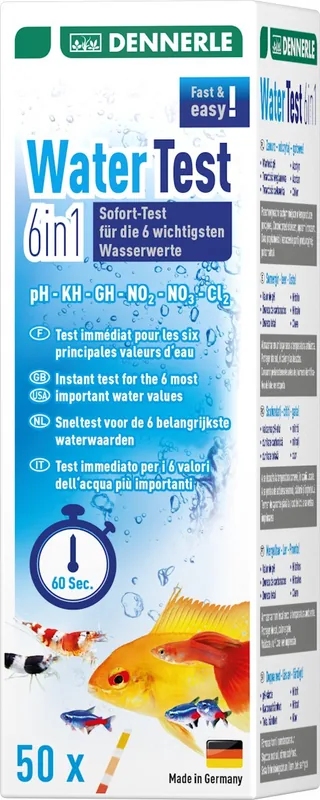
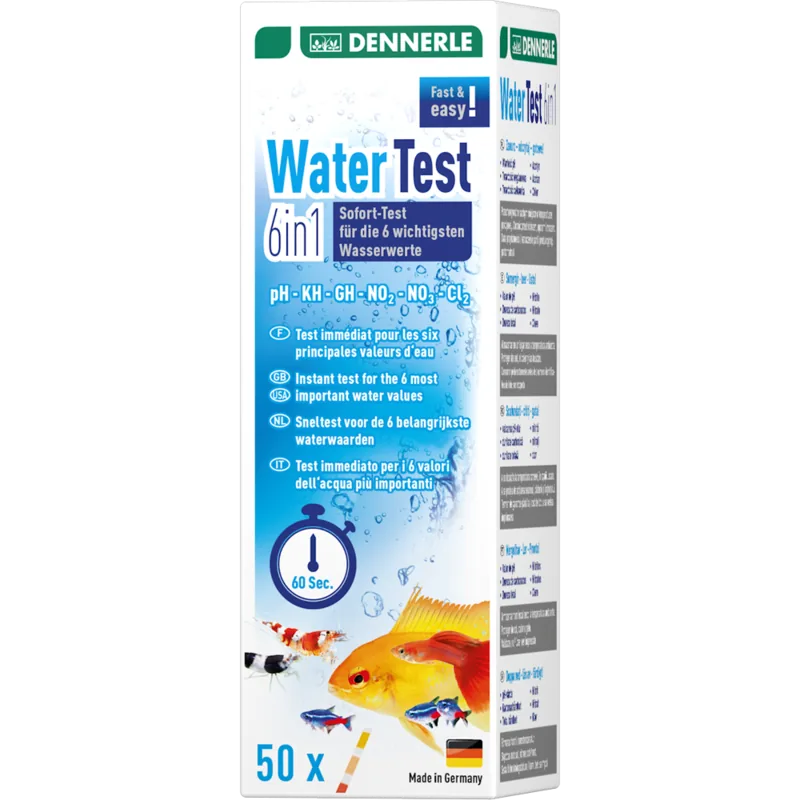
D
WaterT
Zur gleichzeitigen Bestimmung der 6 wichtigsten Wasserwerte im A
1. pH-Wert
Der pH-Wert ist ein Maß für den Säuregehalt des Wassers. Bei pH 7 ist das Wasser neutral, unter 7 sauer
Die meisten Fische fühlen sich in einem Wasser mit neutralem bis leicht saurem pH am wohlsten.
pH-Wert Beurteilung / Maßnahmen
6,4 oder darunter Zu sauer. pH-WDENNERLE KH+ Elixier oder karbonathaltiges Leitungswasser
(messen!) zugeben.
6,8 – 7,6 pH-Wert für die meisten Fische und Pflanzen optimal.
8,0-8,4 Zu hoch. Stress für Fische und Pflanzen. Algenfördernd. pH-Wert senken: W
wasser oder Osmosewasser zugeben, ggf. über T
2
zugeben.
2. Karbonathärte KH
Sie wird gemessen in °d (Deutsche Grad). Wasser aus Kalkgebieten enthält viel Karbonathärte (hartes Wasser). Wasser
aus Granit- oder Sandstein-Gebieten und Regenwasser besitzt kaum Karbonathärte (weiches Wasser). Die Karbonathärte
hat eine wichtige Pufferfunktion.
Karbonathärte °d Beurteilung / Maßnahmen
0 Viel zu niedrig, Wasser ohne Pufferkapazität. pH-Wert instabil, Gefahr für Fische. KH erhöhen:
DENNERLE KH+ Elixier oder KH-haltiges Leitungswasser (messen!) zugeben.
3 Karbonathärte niedrig. KH eventuell etwas erhöhen.
6 - 10 KH für die meisten Fische und Pflanzen optimal.
15 Karbonathärte hoch. KH eventuell etwas senken: Teilwasserwechsel mit Osmosewasser oder
weichem Leitungswasser (messen!).
20 Karbonathärte zu hoch. Mögliche Ursachen z.B. hartes Leitungswasser, kalkhaltiger
Bodengrund, Kalksteine oder –kiesel, zu wenig Wasserwechsel. KH schrittweise senken: s.o.
3. Gesamthärte GH
Die Gesamthärte ist ein Maß für den Gehalt des Wassers an Kalzium- und Magnesiumsalzen. Kalzium ist für die Fische un-
entbehrlich zum Aufbau ihres Knochengerüstes, Wasserschnecken benötigen es für ihr Gehäuse. Kalzium und Magnesium
sind auch für Pflanzen wichtig.
Gesamthärte °d Beurteilung / Maßnahmen
unter 3 Gesamthärte zu niedrig. Wasser zu mineralstoffarm. Schlecht für Fische und Pflanzen. GH
erhöhen: DENNERLE Osmose ReMineral+ oder GH-haltiges Leitungswasser zugeben.
4 - 14 Gesamthärte für die meisten Fische und Pflanzen optimal.
über 21 Gesamthärte zu hoch. Mögliche Ursachen z.B. hartes Leitungswasser, kalkhaltiger
Bodengrund, Kalksteine oder –kiesel, zu wenig Wasserwechsel. GH schrittweise senken:
T
4. Nitrit NO
2
Nitrit ist ein Zwischenprodukt des bakteriellen Abbaus von Eiweißen. Nitrit ist bereits in geringsten Mengen sehr giftig für
Fische! Es wird in einem funktionierenden Aquarium schnell durch Bakterien zum relativ ungefährlichen Nitrat oxidiert.
Nitrit-Gehalt mg/l Beurteilung / Maßnahmen
0 Optimal. Filterbakterien und Filter arbeiten gut.
über 0,5 Nitritabbau gestört bzw. Filterbakterien überlastet. Stress für Fische. DENNERLE Bacto
Elixier FB7 Klarwasser-Filterbakterien einsetzen. Fische nicht füttern, keine weiteren Fische
zusetzen. Filterfunktion prüfen. Fische erst wieder füttern, wenn kein Nitrit mehr nachweisbar
5. Nitrat NO
3
Nitrat ist ein Endprodukt des bakteriellen Abbaus von Eiweißen. Nitrat ist in geringeren Konzentrationen ungiftig für Fische,
höhere Konzentration wirken aber als Stressfaktor und fördern das Algenwachstum.
Nitrat-Gehalt mg/l Beurteilung / Maßnahmen
0 - 25 Gut. Das Aquarium befindet sich in einem natürlichen Gleichgewicht. Kaum Neigung zu Algen.
50 Hoch. Aquarium nicht im Gleichgewicht. Algenfördernd. Abhilfe: Fischbesatz reduzieren,
weniger füttern, häufigerer T
einsetzen (z.B. Hornkraut)!
100 - 500 Zu hoch. Gleichgewicht gestört. Höhere Werte Stress für Fische, erhöhte Krankheitsgefahr
Gefahr von Algenplagen. Abhilfe: siehe oben.
6. Chlor Cl
2
Chlor wird von den Wasserwerken zur Desinfektion des T
und Pflanzen schädigen. Das zum Wasserwechsel oder Nachfüllen ver
Chlor-Gehalt mg/l Beurteilung / Maßnahmen
0 Gut. Leitungswasser für das Aquarium geeignet.
0,8 – 3,0 Gefahr. Leitungswasser für das Aquarium ungeeignet. Abhilfe: DENNERLE Aqua Elixier
Wasseraufbereiter verwenden, Leitungswasser über Aktivkohlefilter zugeben oder vor Zugabe
in separatem Behälter mehrere Stunden belüften.
Vertrieb: DENNERLE GmbH, D-66957 Vinningen
Kundenservice: DENNERLE GmbH, Industriestraße 4, D-66981 Münchweiler
F
WaterT
Pour mesurer simultanément les six principales valeurs d’
1. pH
Le pH est la mesure de l‘
La plupart des poissons se sentent parfaitement bien dans une eau présentant un pH neutre à légèrement acide.
pH Évaluation / mesures correctives
6,4 ou moins TDENNERLE KH+ Elixier ou de l
des carbonates (mesurer !)
6,8 – 7,6 pH optimal pour la plupart des poissons et des plantes.
8,0-8,4 pH T
valeur pH : Ajouter de l’
tourbe humique ou ajouter du CO
2
.
2. Dureté carbonatée KH
Elle est mesurée en °d (degrés allemands). L
(eau dure). L
carbonatée (eau douce). La dureté carbonatée possède une fonction importante de tampon.
Dureté carbonatée °d Évaluation / mesures correctives
0 Beaucoup trop faible, eau sans capacité tampon. pH instable, danger pour les poissons.
Augmenter la dureté carbonatée : Ajouter DENNERLE KH+ Elixier ou de l‘
carbonatée (mesurer !).
3 Dureté carbonatée faible. Éventuellement augmenter un peu la valeur KH :
6 - 10 Valeur KH optimale pour la plupart des poissons et des plantes.
15 Dureté carbonatée élevée. Éventuellement réduire un peu la valeur KH : remplacer partielle-
ment l‘
20 Dureté carbonatée trop élevée. Causes possibles : par exemple eau du robinet dure, substrat
de fond, pierres ou gravier calcaires, changements d‘
la valeur KH : voir ci-dessus.
3. Dureté totale GH
La dureté totale mesure la teneur de l‘
calcium pour la formation de leur squelette tandis que les moules d‘
magnésium sont également importants pour les plantes.
Dureté totale °d Évaluation / mesures correctives
Inférieure à 3 Dureté totale trop basse. Eau trop pauvre en minéraux. Mauvais pour les poissons et les
plantes. Augmenter la dureté totale : Ajouter DENNERLE Osmose ReMineral+ ou de l‘
robinet avec une bonne dureté totale.
4 - 14 Dureté totale optimale pour la plupart des poissons et des plantes.
supérieur à 21 Dureté totale trop élevée. Causes possibles : par exemple eau du robinet dure, substrat de
fond, pierres ou gravier calcaires, changements d‘
la dureté totale : remplacer partiellement l‘
douce (mesurer !).
4. Nitrites NO
2
Les nitrites sont des produits intermédiaires de la dégradation bactérienne des protéines. Ils sont fortement toxiques pour
les poissons, même en très faibles quantités ! Dans un aquarium fonctionnant correctement, ils sont rapidement oxydés
par certaines bactéries en nitrates relativement inoffensifs.
T Évaluation / mesures correctives
0 Optimal. Les bactéries de filtration et le filtre fonctionnent bien.
supérieur à 0,5 La dégradation des nitrites est perturbée ou les bactéries de filtration sont surchargées.
Stress pour les poissons. Utiliser DENNERLE Bacto Elixier FB7 bactéries de filtration
ClearWater. Ne pas nourrir les poissons, ne pas ajouter de nouveaux poissons. Vérifier le
fonctionnement du filtre. Ne recommencer à nourrir les poissons que lorsque les nitrites ne
sont plus détectables.
5. Nitrates NO
3
Les nitrates sont des produits finaux de la dégradation bactérienne des protéines. A faible concentration, ils sont
inoffensifs pour les poissons. Une concentration importante constitue cependant un facteur de stress et favorise la
prolifération des algues.
T Évaluation / mesures correctives
0 - 25 Bonne. L
50 Élevée. L
l‘
remplacements partiels de l‘
ex. cornifle immergé) !
100 - 500 T
maladies. Risques de prolifération des algues.
Solution : voir ci-dessus.
6. Chlore Cl
2
Le chlore est utilisé par les compagnies de distribution de l’
et peut nuire aux poissons et aux plantes. L
exempte de chlore.
T Évaluation / mesures correctives
0 Bonne. L
0,8 – 3,0 Risque. L
Solution : Utiliser DENNERLE Aqua Elixier , un conditionneur d‘
robinet via le filtre à charbon actif ou aérer avant l’
pendant plusieurs heures.
Distribution : DENNERLE GmbH, D-66957 Vinningen - ALLEMAGNE
Service après-vente : DENNERLE GmbH, Industriestrasse 4, D-66981 Münchweiler
WaterT
For simultaneous determination of the 6 most important wat
1. pH-Wert
The pH is a measure of the acidity of the water. At a pH of 7 the water is neutral, under 7 acidic, over 7 alkaline. Most fish
feel happiest in water with a neutral to slightly acidic pH.
pH Assessment / actions
6.4 or under TDennerle KH+Elixier or carbonate-containing tap water
(measure!).
6.8 – 7.6 Optimum pH for most fish and plants.
8.0 - 8.4 T
osmosis water, if necessary filter via peat or add CO
2
.
2. Carbonate hardness CH
It is measured in °dH (German degrees). Water from limestone areas has high carbonate hardness (hard water). Water from
granite or sandstone areas and rain water has low carbonate hardness (soft water). Carbonate hardness has an important
buffering function.
Carbonate hardness °d Assessment / actions
0 Much too low, water has no buffering capacity. pH unstable, risk to fish. R
Dennerle KH+Elixier or carbonate tap water (measure!).
3 Carbonate hardness low. Perhaps increase CH slightly
6 - 10 Optimum CH for most fish and plants.
15 Carbonate hardness high. Perhaps decrease CH slightly
water or soft tap water (measure!).
20 Carbonate hardness too high. Possible causes include hard tap water
limestone rocks or pebbles, insufficient water change. Gradually decrease CH: see above.
3. T
The total hardness is a measure of the amount of calcium and magnesium salts in the water. Calcium is essential to fish
for building their skeletons; water snails require it for their shells. Calcium and magnesium are also important f
T Assessment / actions
under 3 T
Dennerle Osmose ReMineral+ or tap water with a higher total hardness.
4 - 14 Optimum total hardness for most fish and plants.
over 21 T
or pebbles, insufficient water change. Gradually decrease TH: Partial water change with
osmosis water or soft tap water (measure!).
4. Nitrite NO
2
Nitrite is an intermediate product of bacterial degradation of proteins. Nitrite is highly toxic to fish even in minimal
amounts! In a properly functioning aquarium it is quickly oxidised by bacteria to form relatively harmless nitrate.
Nitrite content mg/l Assessment / actions
0 Optimum. Filter bacteria and filter are working well.
Over 0.5 Nitrite degradation impaired or filter bacteria overloaded. Stress for fish. Use Dennerle Bacto
Elixier FB7 clear water filtering bacteria. Do not feed fish, do not add any fish. Check filter
function. Only resume feeding fish when nitrite is no longer detectable.
5. Nitrate NO
3
Nitrate is an end product of bacterial degradation of proteins. In low concentrations, nitrate is non-toxic to fish, but higher
concentrations cause stress and promote algae growth.
Nitrate content mg/l Assessment / actions
0 - 25 Good. The aquarium is naturally balanced. Not prone to much algae growth.
50 High. Aquarium unbalanced. Promotes algae. Solution: Reduce fish population, feed less,
carry out partial water change more frequently. Add as many fast-growing plants as possible
(e.g. hornwort)!
100 - 500 T
of proliferation of algae. Solution: see above.
6. Chlorine Cl
2
Chlorine is used by water treatment works to disinfect drinking water
plants. Water used for water changes or refilling should always be chlorine-free.
Chlorine content mg/l Assessment / actions
0 Good. T
0.8 – 3.0 DangerDENNERLE Aqua Elixier water
conditioner, add tap water via active carbon filter or ventilate in a separate container for
several hours before adding.
Sales: Dennerle GmbH, D-66957 Vinningen
Customer service: Dennerle GmbH, Industriestraße 4, D-66981 Münchweiler
I
WaterT
Per il rilevamento contempor
1. Valor
Il valore pH misura l’
basico. La maggior parte dei pesci vivono al meglio in un’
Valore pH Valutazione / misure
6,4 o inferiore TDENNERLE KH+ Elixier o acqua del
rubinetto contenente carbonato (misurare!).
6,8 – 7,6 Valore pH ottimale per la maggior parte dei pesci e delle piante.
8,0-8,4 Valore pH troppo alto. Stress per pesci e piante. Stimola la crescita di alghe. Ridurre il
valore pH: aggiungere acqua dolce del rubinetto o acqua osmotica, event. filtrare con torba o
aggiungere CO
2
.
2. Durezza carbonatica KH
Si misura in °d (gradi tedeschi). L
L
dolce). La durezza carbonatica ha un’importante funzione tampone.
Durezza carbonatica °d Valutazione / misure
0 T
Aumentare KH: aggiungere DENNERLE KH+ Elixier o acqua del rubinetto contenente KH
(misurare!).
3 Durezza carbonatica bassa. Eventualmente aumentare leggermente KH:
6 – 10 KH ottimale per la maggior parte dei pesci e delle piante.
15 Durezza carbonatica alta. Eventualmente ridurre leggermente KH: cambio parziale dell’
con acqua osmotica o con acqua dolce del rubinetto (misurare!).
20 Durezza carbonatica troppo alta. Possibili cause, p.e. acqua del rubinetto dura, materiale
da fondo calcareo, pietre o ciottoli calcarei, cambio dell
gradualmente KH: come sopra
3. Durezza totale GH
La durezza totale misura il contenuto di sali di calcio e magnesio nell’
il proprio scheletro, alle lumache di acqua dolce serve per la conchiglia. Il calcio e il magnesio sono importanti anche
per le piante.
Durezza totale °d Valutazione / misure
Inferiore a 3 Durezza totale troppo bassa. Acqua troppo povera di sostanze minerali. Sfavorevole per pesci
e piante. Aumentare la durezza totale: aggiungere DENNERLE Osmose ReMineral+ o acqua
del rubinetto con durezza totale.
4 – 14 Durezza totale ottimale per la maggior parte dei pesci e delle piante.
Superiore a 21 Dur
calcareo, pietre o ciottoli calcarei, cambio dell
durezza totale: cambio parziale dell’
(misurare!).
4. Nitrito NO
2
Il nitrito è un prodotto intermedio della metabolizzazione batterica delle proteine. Il nitrito è molto tossico per i pesci già in
minime quantità! In un acquario funzionante, viene rapidamente ossidato da alcuni batteri e trasformato nel relativamente
innocuo nitrato.
Contenuto di nitrito mg/l Valutazione / misure
0 Ottimale. I batteri filtranti e il filtro lavorano bene.
Superiore a 0,5 Disfunzione della metabolizzazione del nitrito e/o batteri filtr
i pesci. Utilizzare DENNERLE Bacto Elixier FB7 batteri filtranti ClearWater. Non dar
mangiare ai pesci e non aggiungerne altri. Controllare il funzionamento del filtro. Riprendere a
nutrire i pesci quando l’
5. Nitrato NO
3
Il nitrato è un prodotto finale della metabolizzazione batterica delle proteine. In concentrazioni minime, il nitrato non è
tossico per i pesci, però concentrazioni più elevate hanno un effetto stressante e stimolano la crescita delle alghe.
Contenuto di nitrato mg/lValutazione / misur
0 – 25 Buono. L
assente.
50 Alto. L
to di pesci, meno mangime e più frequente, cambio parziale dell’
numero possibile di piante a crescita rapida (ad es. ceratofillo sommerso)!
100 – 500 T
malattie. Pericolo di proliferazione delle alghe. Rimedio: come sopr
6. Cloro Cl
2
Il cloro viene utilizzato dagli impianti idrici per disinfettare l
pesci e le piante. L
Contenuto di cloro mg/l Valutazione / misure
0 Buono. Acqua del rubinetto adatta all’
0,8 – 3,0 Pericolo. Acqua del rubinetto non adatta all’
DENNERLE Acqua Elixier, aggiungere acqua del rubinetto fatta passare attraverso un filtro a
carboni attivi oppure fatta ossigenare svariate ore in un contenitore separato prima di essere
utilizzata.
Vendita: DENNERLE GmbH, D-66957 Vinningen
Servizio clienti: DENNERLE GmbH, Industriestrasse 4, D-66981 Münchweiler
WaterT
Voor het gelijktijdig bepalen v
1. pH-waarde
De pH-waarde is een graadmeter voor de zuurgraad van het water. Bij pH 7 is het water neutraal, beneden 7 zuur
basisch. De meeste vissen voelen zich het best in water met een neutrale tot iets zure pH.
pH-waarde Beoor
6,4 of lager TDennerle KH+ Elixier of kalkhoudend leidingwater (meten!)
toevoegen.
6,8 – 7,6 pH-waarde voor de meeste vissen en planten optimaal.
8,0-8,4 pH-waarde te hoog. Stress voor vissen en planten. Bevordert algengroei. pH-waarde verlagen:
Zacht leidingwater of osmosewater toevoegen, eventueel via turf filteren of CO
2
toevoegen.
2. Carbonaathardheid KH
Deze wordt gemeten in °d (Duitse hardheidsgraad). De carbonaathardheid van water uit kalkgebieden is hoog (hard water).
De carbonaathardheid van water uit graniet- of zandsteengebieden en regenwater is nauwelijks aanwezig (zacht water). De
carbonaathardheid heeft een belangrijke bufferfunctie.
Carbonaathardheid °d Beoordeling / maatregelen
0 Veel te laag, water zonder buffercapaciteit. pH-waarde instabiel, gevaarlijk voor vissen. KH
verhogen: Dennerle KH+ Elixier of KH-houdend leidingwater (meten!) toevoegen.
3 Carbonaathardheid laag. KH eventueel iets verhogen.
6 - 10 KH voor de meeste vissen en planten optimaal.
15 Carbonaathardheid te hoog. KH eventueel iets verlagen: gedeeltelijke waterver
osmosewater of zacht leidingwater (meten!).
20 Carbonaathardheid te hoog. Mogelijke oorzaken bijv
bodemgrond, kalksteen of -grind, te beperkte waterver
3. T
De totale hardheid is een maat voor het gehalte calcium- en magnesiumzouten in het water. Calcium is voor de vissen
onontbeerlijk voor de opbouw van hun skelet, waterslakken hebben het nodig voor hun huisje. Ook voor planten zijn calcium
en magnesium belangrijk.
T Beoordeling / maatregelen
beneden 3 T
verhogen: Dennerle Osmose ReMineral+ of GH-houdend leidingwater toevoegen.
4 - 14 T
boven 21 T
bodemgrond, kalksteen of -grind, te beperkte waterver
gedeeltelijke waterver
4. Nitriet NO
2
Nitriet is een tussenproduct van de bacteriële afbraak van eiwitten. Nitriet is zelfs al in de allerkleinste hoeveelheden zeer
giftig voor vissen! Het wordt in een functionerend aquarium door bacteriën snel geoxideerd tot het relatief ongevaarlijke
nitraat.
Nitriet-gehalte in mg/l Beoordeling / maatregelen
0 Optimaal. Filterbacteriën en filter functioneren goed.
boven 0,5 Nitrietafbraak verstoord resp. filterbacteriën overbelast. Stress voor vissen. Dennerle Bacto
Elixier FB7 filterbacteriën voor helder water toevoegen. Vissen niet voeren, geen vissen meer
toevoegen. Filterfunctie controleren. Vissen pas weer voeren als er geen nitriet meer aan te
tonen is.
5. Nitraat NO
3
Nitraat is een eindproduct van de bacteriële afbraak van eiwitten. Nitraat is in lagere concentratie niet giftig voor vissen,
hogere concentraties werken echter als stressfactor en stimuleren de algengroei.
Nitraatgehalte in mg/l Beoordeling / maatregelen
0 - 25 Goed. Het aquarium is in natuurlijk evenwicht. Nauwelijks neiging tot algengroei.
50 Hoog. Aquarium niet in evenwicht. Algengroei wordt bevorderd. Remedie: visbezetting
verkleinen, minder voeren, vaker gedeeltelijke waterver
planten plaatsen (bijv. fijn hoornblad)!
100 - 500 T
ziektes. Gevaar voor algenplaag. Remedie: zie boven.
6. Chloor Cl
2
Chloor wordt door de waterleidingbedrijven gebruikt voor het desinfecteren van drinkwater. Chloor is zeer agressief en kan
vissen en planten beschadigen. Het voor de waterver
Chloor-gehalte in mg/l Beoor
0 Goed. Leidingwater voor het aquarium geschikt.
0,8 – 3,0 Gevaar. Leidingwater voor het aquarium ongeschikt. RDennerle Aqua Elixier water-
behandelingsmiddel gebruiken, leidingwater via actiefkoolfilter toevoegen of voor toevoegen
meerdere uren lang beluchten in separaat reservoir
Verkoop: DENNERLE GmbH, D-66957 Vinningen
Klantenservice: Dennerle GmbH, Industriestraße 4, D-66981 Münchweiler
WaterT
K současnému určení 6 nejdůležitějších hodnot pro kvalitu v
1. Hodnota pH
Hodnota pH je veličinou pro měření kyselosti vody. Při pH 7 je voda neutrální, pod 7 kyselá a nad 7 zásaditá. Většina rybiček
se nejlépe cítí ve vodě s neutrální až lehce kyselou hodnotou pH.
Hodnota pH Hodnocení / opatření
6,4 nebo nižší Příliš kyselá. Zvýšení hodnoty pH: Přidejte přípravek Dennerle KH+Elixier nebo kohoutkovou
vodu s obsahem uhličitanů (změřte!).
6,8 až 7,6 Optimální hodnota pH pro většinu rybiček a rostlin.
8,0 až 8,4 Hodnota pH Hodnota je příliš vysoká. Stres pro rybičky a rostliny. Podporuje růst řas. Snížení
hodnoty pH: Přidejte měkkou vodu z kohoutku nebo osmotickou vodu, popř
rašelinu nebo přidejte CO
2
.
2. Uhličitanová tvrdost KH
Měří se v °d (německý stupeň). Voda z oblastí s výskytem vápence obsahuje velké množství uhličitanů (tvrdá voda). Voda z
oblastí s výskytem žuly a pískovců a dešťová voda téměř žádné uhličitany neobsahuje (měkká voda). Uhličitanová tvrdost
má důležitou regulační funkci.
Uhličitanová tvrdost °d Hodnocení / opatření
0 Příliš nízká, voda nemá regulační kapacitu. Hodnota pH je nestabilní, nebezpečí pro rybičky.
Zvýšení KH: Přidejte prostředek Dennerle KH+Elixier nebo kohoutkovou vodu s obsahem
uhličitanů (změřte!).
3 Nízká uhličitanová tvrdost. Uhličitanovou tvrdost případně trochu zvyšte.
6 až 10 Optimální uhličitanová tvrdost pro většinu rybiček a rostlin.
15 Vysoká uhličitanová tvrdost. KH případně o něco snižte: Částečná výměna vody vodou
upravenou osmózou nebo měkkou kohoutkovou vodou (změřte!).
20 Příliš vysoká uhličitanová tvrdost. Možné příčiny jsou např. tvrdá kohoutk
podloží, kameny nebo oblázky s obsahem vápence, nedostatečná výměna vody. Postupné
snížení hodnoty KH: viz výše.
3. Celková tvrdost GH
Celková tvrdost je veličinou pro měření obsahu vápníku a hořčíku ve vodě. Vápník je pro rybičky nepostradatelný pro tvorbu
kosterní soustavy, vodní šneci jej potřebují pro stavbu ulity
Celková tvrdost °d Hodnocení / opatření
nižší než 3 Celková tvrdost je příliš nízká. Voda má nedostatečný obsah minerálů. T
a rostliny. Zvýšení celkové tvrdosti (GH): Přidejte přípravek Dennerle Osmose ReMiner
nebo tvrdou kohoutkovou vodu.
4 až 14 Optimální celková tvrdost pro většinu rybiček a rostlin.
vyšší než 21 Příliš vy
podloží, kameny nebo oblázky s obsahem vápence, nedostatečná výměna vody. Postupné
snížení hodnoty GH: Částečná výměna vody za vodu upravenou osmózou nebo měkkou
kohoutkovou vodu (změřte!).
4.Nitrid NO
2
Nitrid je meziproduktem bakteriálního rozkladu bílkovin. Nitrid je pro rybičky velmi jedovatý již ve velmi malém množství! Ve
fungujícím akváriu jej bakterie rychle oxidují na relativně bezpečný nitrát.
Obsah nitridu mg/l Hodnocení / opatření
0 Optimální. Bakterie ve filtru a filtr pracují dobře.
vyšší než 0,5 Odbourávání nitridu narušeno, resp. nadměrná zátěž bakterií ve filtru. Stres pro rybičky.
Přidejte filtrační bakterie pro čistou vodu Dennerle Bacto Elixier FB7 . Rybičky nekrmte, ani
žádné nepřidávejte. Zkontrolujte funkci filtru. Rybičky nakrmte, až když nebude prokázán žádný
obsah nitridu.
5. Nitrát NO
3
Nitrát je koncovým produktem bakteriálního rozkladu bílkovin. V nízkých koncentracích není nitrát pro rybičky jedovatý
vyšších koncentracích však působí jako stresový faktor a podporuje růst řas.
Obsah nitrátu mg/l Hodnocení / opatření
0 až 25 Hodnota je dobrá. Akvárium je v přirozené rovnováze. Téměř žádný sklon k tvorbě řas.
50 Hodnota je vysoká. Akvárium není v rovnováze. Podporuje růst řas.
Odstranění: Snižte počet rybiček, méně krmte, častěji měňte část vody. Zasaďte co nejvíce
rychle rostoucích rostlin (např. růžkatec).
100 až 500 Hodnota je příliš vysoká. Rovnováha narušena. Vysoké hodnoty znamenají stres pro rybičky a
zvýšené nebezpečí onemocnění. Nebezpečí rozsáhlého výskytu řas.
Odstranění: viz výše.
6. Chlór Cl
2
Chlór používají vodárny na dezinfekci pitné vody. Chlór je velmi agresívní a může šk
používaná při výměně nebo doplnění vody by měla být vždy bez chlóru.
Obsah chlóru mg/l Hodnocení / opatření
0 Hodnota je dobrá. Je vhodné použít vodu z kohoutku.
0,8 až 3,0 Nebezpečí. Není vhodné použít vodu z kohoutku. Odstranění: Použijte přípravek na úpravu
vody Dennerle Aqua Elixier, vodu z kohoutku přidávejte přes filtr s aktivním uhlím nebo ji před
přidáním nechte několik hodin provzdušnit v samostatné nádobě.
Distribuce: Dennerle GmbH, D-66957 Vinningen
Zákaznický servis: Dennerle GmbH, Industriestraße 4, D-66981 Münchweiler
WaterT
Para determinar a la vez los 6 v
1. Valor de pH
El valor de pH es una medida que indica la acidez del agua. Con un valor de pH 7 el agua es neutra, por debajo de 7 es ácida
y, por encima de 7, alcalina. La mayoría de los peces prefiere un agua con un valor de pH neutro o ligeramente ácido.
Valor de pH Evaluación / Qué hacer
6,4 o inferior Demasiado ácido. Aumentar el valor de pH: añadir DENNERLE KH+ Elixier o agua corriente
carbonatada (¡midiéndola!).
6,8 – 7,6 Valor de pH óptimo para la mayoría de peces y plantas.
8,0-8,4 Valor de pH Demasiado alto. Estresa a peces y plantas. F
Disminuir el valor de pH: Añadir agua corriente blanda o agua de ósmosis; en caso necesario,
filtrándola a través de turba o añadiendo CO
2
.
2. Dureza de carbonatos (kH)
Se mide en °d (grado alemán). El agua de terrenos calcáreos contiene mucha dureza de carbonatos (agua dura). El agua de
terrenos graníticos o de asperón y el agua de la lluvia apenas contiene dureza de carbonatos (agua blanda). La dureza de
los carbonatos tiene una importante función de amortiguación.
Dureza de carbonatos °d Evaluación / Qué hacer
0 Demasiado bajo; el agua no tiene capacidad amortiguadora. El valor del pH es inestable y
resulta peligroso para los peces. Aumentar la dureza de los carbonatos: añadir DENNERLE
KH+ Elixier o agua corriente dura (¡midiéndola!).
3 Dureza de carbonatos baja. Dado el caso, aumente algo la dureza de los carbonatos.
6 - 10 Dureza de carbonatos óptima para la mayoría de peces y plantas.
15 Dureza de carbonatos alta. Dado el caso, reduzca algo la dureza de los carbonatos: cambiar
parcialmente el agua con agua de ósmosis o agua corriente blanda (¡midiéndola!).
20 Dureza de carbonatos demasiado alta. Las causas posibles son, por ejemplo, agua corriente
dura, sustrato calcáreo, piedra caliza o guijarros, cambio de agua muy poco frecuente. R
gradualmente la dureza de los carbonatos: vid. supra.
3. Dureza total
La dureza total es un valor que mide el contenido en calcio y sales de magnesio del agua. El calcio es esencial para la
formación del esqueleto de los peces y los caparazones de las caracolas. El calcio y el magnesio también son importantes
para las plantas.
Dureza total °d Evaluación / Qué hacer
Por debajo de 3 Dureza total demasiado bajo. Agua demasiado pobre en minerales. Perjudicial para peces y
plantas. Aumentar la dureza total: añadir DENNERLE Osmose ReMineral+ o agua corriente
con dureza total.
4 - 14 Dureza total óptima para la mayoría de peces y plantas.
Por encima de 21 Dur
sustrato calcáreo, piedra caliza o guijarros, cambio de agua muy poco frecuente.
Reducir gradualmente la dur
agua corriente blanda (¡midiéndola!).
4. Nitrito (NO
2
)
El nitrito es una sustancia intermedia resultante de la degradación bacteriana de proteínas. El nitrito es altamente tóxico
para los peces incluso en cantidades mínimas. En acuarios en funcionamiento se convierte rápidamente en un nitrato
relativamente inocuo por la acción de las bacterias.
Contenido de nitrito mg/l Evaluación / Qué hacer
0 Óptimo. Las bacterias filtrantes y el filtro hacen bien su trabajo.
Por encima de 0,5 La desnitrificación altera y sobrecarga a las bacterias filtrantes. Estrés para los peces.
Emplear bacterias filtrantes DENNERLE Bacto Elixier FB7 . No alimentar a los peces ni aña-
dir nuevos peces. Comprobar que el filtro funciona. Volver a alimentar a los peces únicamente
cuando ya no se detecte nitrito.
5. Nitrat NO
3
El nitrato es una sustancia final resultante de la degradación bacteriana de proteínas. En bajas concentraciones el nitrato
no es tóxico para los peces, pero concentraciones mayores tienen un efecto de estrés y favorecen el crecimiento de algas.
Contenido de nitrato mg/l Evaluación / Qué hacer
0 - 25 Adecuado. El acuario se encuentra en equilibrio natural. Escasa formación de algas.
50 Alto. El acuario no está en equilibrio. Se favorece el crecimiento de algas. Ayuda: reducir el
volumen de peces, alimentarlos en menor cantidad pero con más frecuencia, efectuar un
cambio parcial de agua. Utilizar la mayor variedad posible de plantas de crecimiento rápido (p.
ej. Cerastium).
100 - 500 Demasiado alto. Se altera el equilibrio. Unos valores más altos pueden provocar el estrés de
los peces y aumentar el riesgo de enfermedades. Peligro de prolif
supra.
6. Cloro Cl
2
Las empresas abastecedoras de agua utilizan cloro para desinfectar el agua potable. El cloro es muy agresivo y puede
resultar dañino para peces y plantas. El agua utilizada para cambios o llenados no debe contener nunca cloro.
Contenido de cloro mg/l Evaluación / Qué hacer
0 Adecuado. El agua corriente es apropiada para el acuario.
0,8 – 3,0 Peligro. El agua corriente no es apropiada para el acuario. A
agua DENNERLE Aqua Elixier , añadir el agua corriente a través de filtros de carbón activo o
ventilarla en un recipiente separado durante varias horas antes de añadirla.
Ventas: DENNERLE GmbH, D-66957 Vinningen (Alemania)
Atención al cliente: DENNERLE GmbH, Industriestrasse 4, D-66981 Münchweiler (Alemania)
WaterT
Do jednoczesnego badania 6 najważniejszych wart
1. Wartość pH
Wartość pH jest miarą kwasowości wody. Przy pH 7 woda jest neutralna, poniżej 7 kwaśna, powyżej 7 zasadowa. Większość
ryb czuje się najlepiej w wodzie o pH od neutralnego do lekko kwaśnego.